%20(1).png?width=1251&height=820&name=Via%20product%20showcase%20(3)%20(1).png)
When data is easy to access—and even easier to act on—teams move faster, make better calls, and avoid last-minute fire drills.
Our latest updates focus on exactly that: helping you turn insight into action from the earliest stages of service design, through smarter supply planning, and all the way to day-of paratransit operations.
This month we cover:
- Real-time service design
- Smart supply planning
- Modernizing paratransit operations
A quick note: we shared all of these features in action during our live Product Updates webinar. Missed it and want to make sure you’re in the know next time? Sign up for our newsletter.
Real-time service design.
Designing effective demand-response service can’t be a “set it and forget it” process. You need the ability to adjust quickly—then keep improving based on what you’re seeing in the real world.
%20(1)%20(1).webp?width=2397&height=1640&name=Service%20Design%20Blog%20(2)%20(1)%20(1).webp)
That’s why we’ve continued investing in Service Design, our end-to-end platform for managing demand-response service. It started with the essentials—publishing holiday exceptions, service hours, and quick stop or zone edits to riders in clicks. Now, it’s built to support continuous improvement across your network, so you can spot opportunities and make meaningful changes with confidence.
Here are the latest features to help you take service to the next level:
Build better intermodal connections. You can easily assess how demand-response integrates with fixed routes and transfers. For example: if a microtransit zone stops just short of a key bus terminal, you can adjust the zone boundary, set the transfer point, and improve intermodal connections—right away.
Leverage AI-powered zone and stop recommendations. Make informed decisions to improve service based on robust travel pattern data in our system. We can suggest expanding a zone with a high volume of trip requests at its’ edge, just outside a key POI like Walmart. You still make the call, but the system helps surface what’s worth a closer look.
Learn more about how Service Design can help you improve your service.
Smart supply planning.
Planning fixed route, microtransit, and paratransit in separate tools can hide inefficiencies—and make it harder to coordinate service as one network.
%20(1).png?width=2880&height=1804&name=png%20(3)%20(1).png)
Plan across modes in one place
Our multimodal scheduling tool lets you view and plan fixed-route, paratransit, and microtransit shifts together in a single interface, so you can spot efficiency gains and resource gaps across the full system.
Coming soon: AI-powered schedule optimization
Soon, you’ll be able to generate optimized schedules based on the criteria that matter most to your agency—cost and ridership—and implement a balanced plan in just a few clicks.
Modern paratransit operations.
We know teams running paratransit are balancing a lot. From eligibility requirements, fair access, cost control, and the day-to-day realities of live operations, delivering quality service requires diligence and coordination across teams. These updates are designed to make that work easier—so information stays in one place and you can act faster, together.
End-to-end Eligibility Management.
.png?width=1128&height=777&name=01%20-%20End%20to%20End%20Elgibility%20Management%20(1).png)
We’ve continued investing in our Eligibility Management platform so your team can manage renewals, assessments, and appeals without spreadsheets or scattered follow-ups.
- Stay ahead of renewals (and reduce churn)
Filter approved riders by upcoming expirations, generate renewal letters in bulk, and automatically tag renewal applications when they come back in—so fewer riders fall through the cracks. - Keep assessments moving—without manual tracking
Route riders into an “Assessment Required” flow, add appointment dates, and track status, files, and notes in one place—including a clear view for cases with no appointment set. - Handle appeals with a cleaner process and audit trail
Initiate appeals directly from denials, track hearings, store documentation, and record final decisions in the VOC—so the full story is easy to follow.
Want a refresher on earlier capabilities? York Region Transit has saved a full work week each month with AI-powered application scanning.
Learn more about Eligibility Manager or paratransit with Via here.
Rider Suspensions Keep Service Fair.
Rider suspensions play an important role in keeping paratransit service safe, reliable, and fair. They’re an important lever to protect on-time performance and productivity by reducing repeated no-shows and late cancellations that waste vehicle hours. Additionally, they provide a clear, consistent way to address serious safety or conduct issues. So how can you use Via’s feature?
%20(1).png?width=829&height=434&name=Rider%20Suspensions%20-%20Blog%20hero%20(1)%20(1).png)
In general, you’ll want to apply suspensions individually when the decision requires context and judgment—think behavior or safety incidents, disputed patterns, or cases where you need rider-specific conditions and documentation for potential appeals. Bulk suspensions, on the other hand, can be best used when you’re enforcing an objective, policy-based rule at scale—like crossing a no-show threshold, or unreasonable, repeat cancellations.
Save service for eligible riders and keep costs in check.
Live Service Management Made Easy.
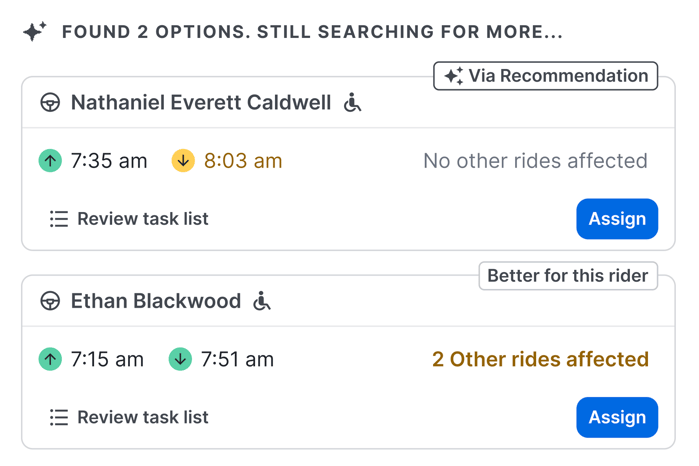 We’re extremely excited to release new features that help dispatch teams move faster and make effective decisions. When service changes mid-day, dispatchers need speed—and confidence that the decision won’t create new issues downstream. Here are two updates that do just that:
Coming soon: Faster trip reassignments with tradeoffs surfaced by AI. When you need to reassign rides, AI surfaces recommendations and shows their implications—so you can quickly compare options and understand service impact before you act.
Seamless overflow support when needed. If overflow providers are required, you can send rides directly from the schedule to help protect on-time performance.
That’s a wrap!
Whether you’re adjusting service, balancing supply across modes, or making day-of dispatch decisions, the goal is the same: give your team clearer insight—and make it easy to act with confidence.
These features are built to help you move faster, stay consistent, and continuously improve service without adding complexity. If you want to see what else is new, reach out to your Via team for a walkthrough below.
📩 Want to be the first to know about new features? Sign up for our newsletter to join the next Product Updates webinar.


