In 2015, a senior woman crossing Washington Street in Hoboken was struck and killed by a driver. Ravi Bhalla, then a city councilman, went to her funeral.
"Attending her funeral and observing the shock of that experience, it made me think, is there something that we can do in Hoboken that could have prevented that death?"
He had two small children at the time, and like most parents, he wanted to live somewhere his kids could cross the street without fear.
"What we are doing at the local level and local government, with our streets and roads, can actually be a matter of life and death."
A crisis America has learned to ignore
More than 100 people die on American roads every day — roughly 40,000 lives a year, plus another 2.5 million serious injuries. In 2024, drivers struck and killed more than 7,000 pedestrians and over 1,000 cyclists.
America's record is dramatically worse than every other high-income nation's, and it barely registers as news. As former Transportation Secretary Pete Buttigieg has put it, we treat roadway deaths as inevitable — "as if we were all living in a country at war for as long as we can remember."
They aren't inevitable. More than 60 U.S. cities and towns have committed to Vision Zero, with mixed results. In Hoboken, the results have been extraordinary: nearly ten years without a single traffic fatality, and not one death on the city's streets during Bhalla's entire tenure as mayor.
Washington Street
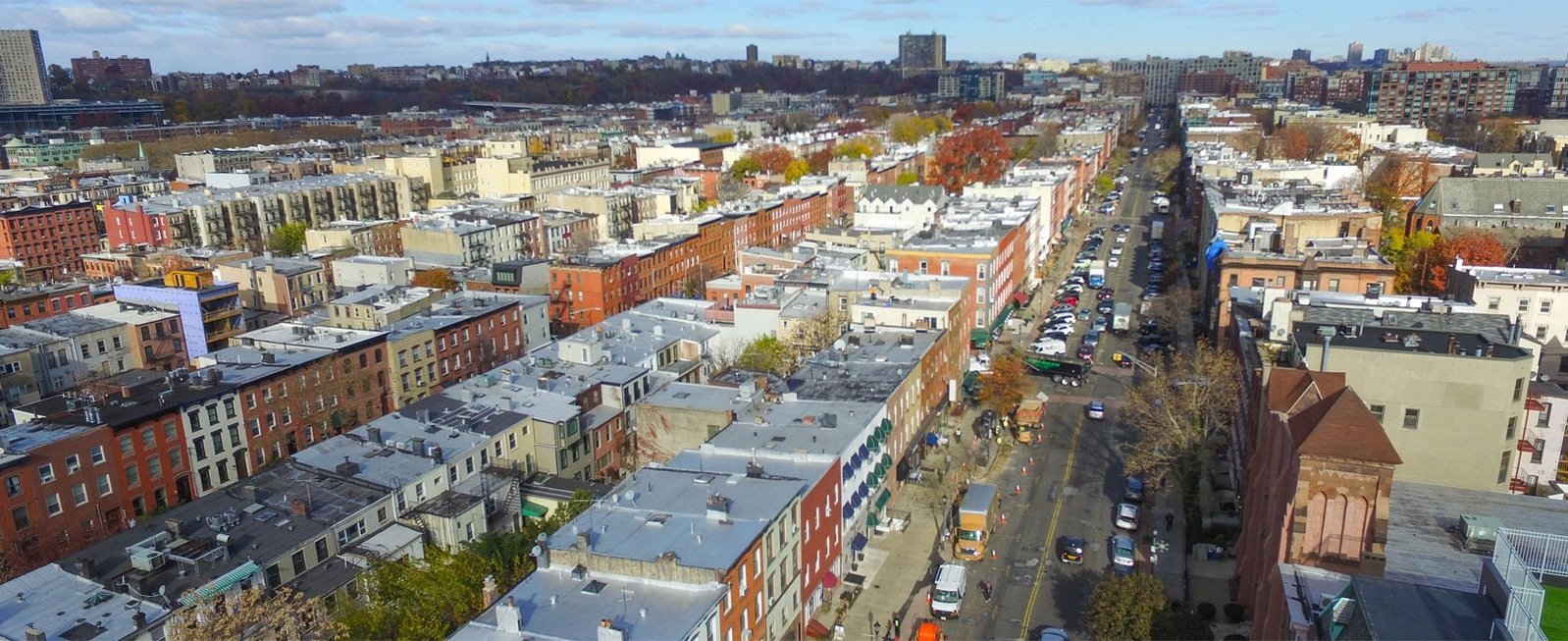
Image courtesy of hobokennj.gov
Bhalla moved to Hoboken in 2000 and fell for it immediately — but something felt off from day one.
“I had my daughter in a stroller, and pushing a stroller across Washington Street. That really meant literally pushing my daughter into the line of traffic to just identify whether I should cross the street.”
Washington Street is Hoboken's heartbeat: shops and restaurants lining blocks of 19th-century brick. It should be a perfect place to walk and bike. For years it wasn't — cars moved fast and there was nowhere safe to ride.
Bhalla won a council seat in 2009 and the mayoralty in 2017, on a platform that included street safety. The math made his case for him. Nearly 60,000 people live inside Hoboken's single square mile, so prioritizing people over cars wasn't a luxury — it was the only design that made sense.
In 2019 he established a Vision Zero Task Force, borrowing from the original Swedish program launched in 1997 — an approach built on a deceptively simple premise: responsibility for safety belongs to the people who design the system, not the people using it.
Not everyone was thrilled.
“People saying that I'm waging a war on cars. People were very upset about bike lanes… I had to communicate to people that I can't outlaw bikes. I can't outlaw walking, I can't outlaw cars. So ultimately, what we're gonna have to do as a community is find a way for all of us to live together and also in a way that's safe for everybody.”
The method: one block at a time
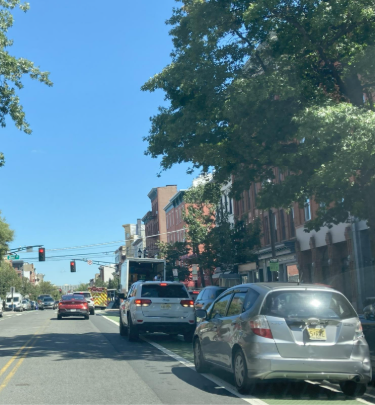 Image courtesy of hobokennj.gov
Ask Bhalla what separates Hoboken from cities that adopted Vision Zero and stalled, and he doesn't point to a single intervention. He points to sequencing.
The core tactic was incrementalism: no sweeping changes without community input, and pilots targeted at "high crash networks" — intersections where data showed an elevated likelihood of conflict. Run it six months on a few blocks. Establish proof of concept. Then expand.
Curb extensions, or "bump outs," are the clearest example. Washington Street now has them on all four corners of all 17 intersections. They widen sidewalk space, shorten the crossing distance, and eliminate the parking spots that block sightlines at corners. They were not popular at first — not even with his own city council.
"When we proposed them for all 17 blocks of Washington Street, what we had to do is start just by one block… and the sky didn't fall. Like, it's like the world didn't end when we did that."
Crossings got easier. Pedestrians got advance signal timing. And the council members who had told Bhalla to keep the bump outs downtown, away from their own wards, changed their minds as construction crept uptown.
"By the time we got to like 14th Street, those same council members who were asking me not to place a curb extension or bump out were actually requesting them in different parts of their wards, because we established a proof of concept."
His summary: "No silver bullet, definitely. But if you do things piece by piece, I think you get a more holistic approval of the approach."
The parking fight that wasn't
Removing parking is usually political kryptonite. Bhalla's answer is that Hoboken mostly didn't remove any.
"Parking spaces — and I say parking spaces with air quotes — were parking spaces that were not legally permissible in the first place."
New Jersey law already prohibits parking within 25 feet of an intersection, so daylighting those corners enforced a rule that existed on paper but not on the street. On several blocks, the redesign actually increased supply by converting to back-in angled spaces.
"Our priority here is people, not cars."
The city also set a citywide speed limit of 20 miles per hour, dropping to 15 near schools and in areas with high concentrations of children or seniors.
CLEAR, and the surveillance question
The most contested initiative was CLEAR, an automated enforcement pilot that photographs vehicles double parking or blocking bike lanes.
Bhalla rejects the surveillance framing: the system captures an image of a license plate, and that image alone doesn't generate a ticket. A human enforcement officer reviews the footage and confirms the violation before any summons is issued.
The behavioral effect was almost immediate once the pilot was announced.
“All of a sudden, there was no double parking. The bike lanes were clear. The loading zones were turning over, so trucks were not idling there for hours. People were not parking in bus lanes.”
When buses can pull up to the curb, passengers step onto the sidewalk instead of a live traffic lane — and cyclists aren't forced to guess their way around a bus blocking both the bike lane and the driving lane. It's why Bhalla treats transit as inseparable from street safety. Roughly 60% of Hoboken residents take transit to work, which he says is the highest share in America.
"Mass transit is integral to Vision Zero, because the city's has to make sure that the streets are engineered in a way that makes mass transit a net positive for safe streets, not the other way around."
What it did to business
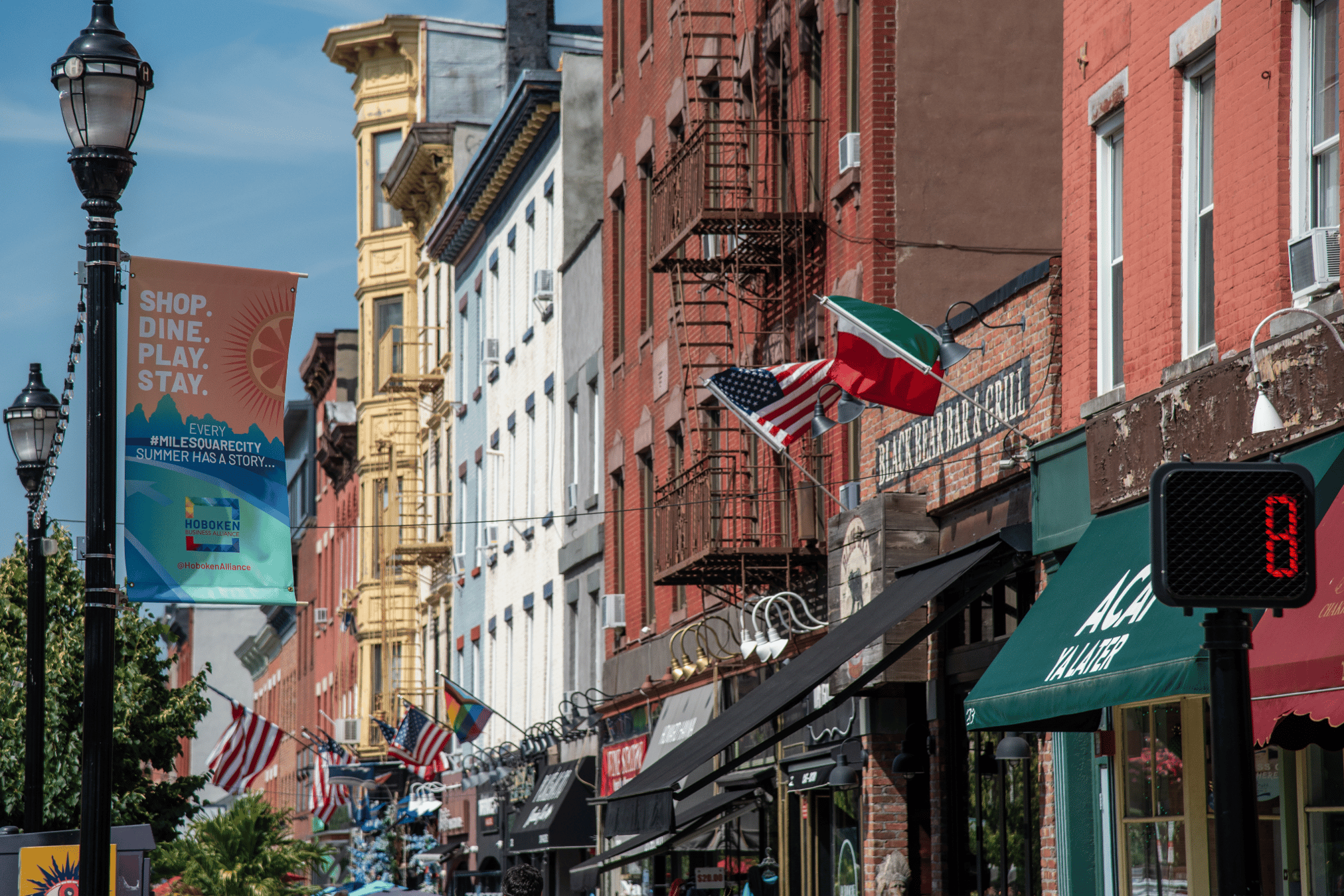
Image courtesy of NJ.com
The standard objection to bike lanes and traffic calming is that they kill foot traffic. Hoboken saw the opposite. Washington Street and First Street — the city's two main commercial corridors — got busier, and dynamic meter pricing increased turnover for the drivers who do come by car.
"Sending the message that Washington Street is open for business for everybody… has had a net, I think, beneficial impact on our businesses."
"Use our city as a city lab"
The most common dismissal Bhalla hears is that Hoboken is too small and too dense for its lessons to travel.
"Use our city as a city lab, a case study. We're not a huge city, but we have very narrow streets, which create their own challenges for cyclists… and they create challenges for motorists as well."
The transferable part isn't the geometry, he argues — it's the process. Identify your specific challenges. Pilot. Measure. Expand. Expect a menu of measures, not a single fix.
He now takes that argument to Trenton as the assemblyman for District 32, where he says much of New Jersey's street infrastructure is antiquated — including in towns that consider themselves progressive on everything else. His pitch to legislators and mayors is partly moral, partly practical: done well, these projects have political upside.
"I see a need to reimagine our streets as being not for cars, but for people."
The results, and what's next
Through Vision Zero, Hoboken has driven traffic fatalities to zero and cut serious injuries by 78%. The city's stated goal is zero fatalities and zero serious injuries by 2030.
Bhalla's advice to his successor, Mayor Emily Jabbour, who took office in January:
"Dream big, have a vision. Be ambitious, and then understand that it'll take cooperation, coordination, and incremental change to actually achieve those ambitious goals. We've already set the foundation, we've already provided a proof of concept."
Ravi Bhalla represents District 32 in the New Jersey State Assembly. He served as mayor of Hoboken from 2018 to 2026.
This article is adapted from an episode of ModeShift, a podcast about the past, present, and future of how we move, hosted by Andrei Greenawalt, Chief Policy Officer at Via. ModeShift is produced by Latitude Media in partnership with Via. Listen at ridewithvia.com or wherever you get your podcasts.


