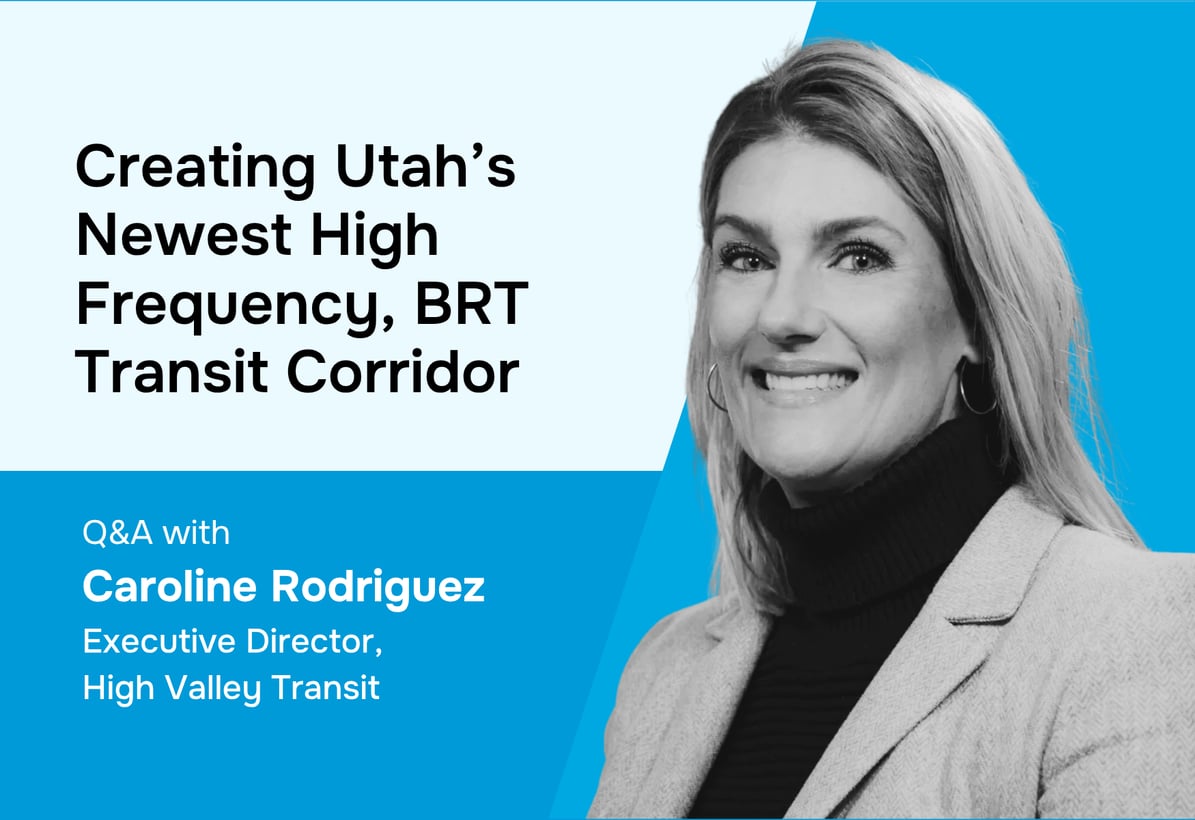
If you’ve driven the seven-mile stretch of State Route 224 between Kimball Junction and Park City lately, you’ve seen the orange cones and the hum of activity. This isn’t just another road widening project; it’s the birth of a more connected Wasatch Back using Bus Rapid Transit on an existing high frequency corridor.
At the helm of this transformation is Caroline Rodriguez, Executive Director of High Valley Transit (HVT). Since HVT’s inception in 2021, Rodriguez has been the architect of a transit revolution in Summit County, moving away from "the way we’ve always done it" toward a tech-forward, rider-centric model that integrates multiple transit modes to grow ridership.
We sat down with Caroline to discuss the SR 224 Bus Rapid Transit (BRT) project, the $110 million funding puzzle, and how a partnership with Via is supporting workforce and tourism demands.
The Interview
Q: Caroline, we are standing at a literal crossroads. BRT construction is ramping up this Spring. How does it feel to see the SR 224 BRT move from blueprints to bulldozers to operation?
Caroline Rodriguez: It’s incredibly rewarding. This project has been in the collective consciousness of Park City and Summit County for over 15 years. To finally be in the phase where we are moving medians and preparing for dedicated bus lanes feels like we’re finally delivering on a long-standing community promise. My history with this corridor goes back to my time as the County’s transportation director, so seeing this evolution into a true BRT system - one that can bypass the gridlock we all know too well - is personal for me.
%20(1).jpg?width=3200&height=1800&name=02-2026_HVT_Stylized%20Map_Presentation%20(3)%20(1).jpg)
Q: For those unfamiliar, what exactly does "BRT" look like on the 224?
Rodriguez: It’s all about reliability. We’re adding 12-foot dedicated transit lanes in each direction, elevate platforms, and signal prioritization. When you’re in a bus, you shouldn’t be stuck behind a sea of SUVs heading to the ski resorts or Park City’s Historic Main Street and Old Town. you should be sailing past them. We are upgrading stations, adding high-visibility crosswalks, and fixing important intersections (Park Ave and Deer Valley Drive) to move buses and (even) cars and more efficiently. It’s about making the BRT buses the obvious choice, not the "alternative" choice.
Q: Let’s talk numbers. This is a $109.9 million investment. How did the BRT funding strategy come together, especially with the recent $45 million boost from the Utah Transportation Commission?
Rodriguez: It’s a "it takes a village" scenario. Our funding is a sophisticated blend of federal, state, and local dollars. We’ve worked closely with the Federal Transit Administration (FTA) through their BUILDs program, which requires rigorous environmental and design standards. The $45 million from the state was a massive milestone - it validated the project’s regional importance. Combine that with local sales tax and contributions from Summit County and Park City, and we have a fully funded vision. We’ve even moved to a "Guaranteed Maximum Price" contract to protect taxpayers from the "change order" creep that can plague public trust in large infrastructure projects.
Q: HVT has gained national attention for its partnership with Via. How does that technology play into BRT operations?
Rodriguez: Via is the "brain" behind our day-to-day and long-term planning and operations. While the BRT will become the high-frequency backbone - replacing and supercharging the old 10 White Express route—our Via-powered microtransit system is what feeds it. We will use Via’s algorithms to provide on-demand rides that bring people from their front doors to the BRT stations. Via has helped us solve the first/last mile issue that has plagued transit for so many years, and the potential for a fully integrated BRT, fixed route, and on-demand network is incredibly exciting.
On the ops side, Via’s tech gives us real-time data that we never had before. We can see exactly where the bottlenecks are and how many people are moving through the system. For the BRT, that means we can maintain "headway-based" scheduling and on-time-performance goals. We aren’t just following a static paper map anymore; we’re responding to the actual pulse of the corridor and meeting riders where and when they want to be met.
Q: You’ve just launched a Community Advisory Board. Why is that stakeholder involvement so critical right now with the BRT corridor under construction?
Rodriguez: Because we’re working in people’s backyards. Whether it’s the sensitive and historic McPolin Barn area or the businesses near our Utah Olympic Park, we have to be transparent. The Advisory Board helps us reality-check our construction schedules and impacts. For example, we’ve committed to no work during major holidays or events like the Arts Festival, and trying to work at night whenever possible. We want the community to feel like this is their project, not something being done to them. We even have a big reveal coming on April 3rd—a new public name and brand for the BRT that reflects our local identity.
%20(1).jpg?width=10544&height=5515&name=2024_1204_Cross%20Section%20(1)%20(1).jpg)
Q: Looking ahead, the 2034 Utah Winter Olympics are on the horizon. How does the BRT project fit into that "Big Picture"?
Rodriguez: The 224 BRT is the foundation. During an Olympic event, we estimate this corridor will need to move upwards of 50,000 people a day. You can’t do that with more asphalt for private cars. You do it with high-frequency, high-capacity transit. But more importantly, this is for the person working a double shift at a resort or the local student trying to get to their soccer game without sitting in 45 minutes of traffic. By the time we completely finish in 2028, the Wasatch Back will be one of the most transit-connected mountain regions in the world.
Q: Any final words for the commuters facing the orange cones this summer?
Rodriguez: Just a huge "thank you" for your patience. We’re doing the most disruptive work at non-peek hours, keeping the two-lane flow open during the day. It’s going to be a busy summer, but the payoff - a 10-minute reliable ride from Kimball to Old Town - BRT is going to change our lives.
Project Snapshot: SR 224 Bus Rapid Transit
- Total Distance: 7+ Miles
- Target Completion: Fall 2028
- Elements: Raised Boarding Stations, Battery Electric Busses, Transit Signal Prioritization, and Fare-Free
- 2026 Focus: Olympic Blvd to Canyons Drive; critical Intersections and station preparations.
- Key Partners: Summit County, Park City, UDOT, FTA, and Via.
- Tech Edge: Integrated microtransit-to-BRT routing using the High Valley Transit tech platform, provided by Via.
For real-time construction updates and to sign up for the newsletter, visit HighValleyTransit.org
Interested in conversations like this?
Subscribe to Inside City Hall, a new series powered by Via featuring candid 20-minute interviews and in-depth conversations with the leaders shaping mobility in their communities - delivered straight to your inbox.