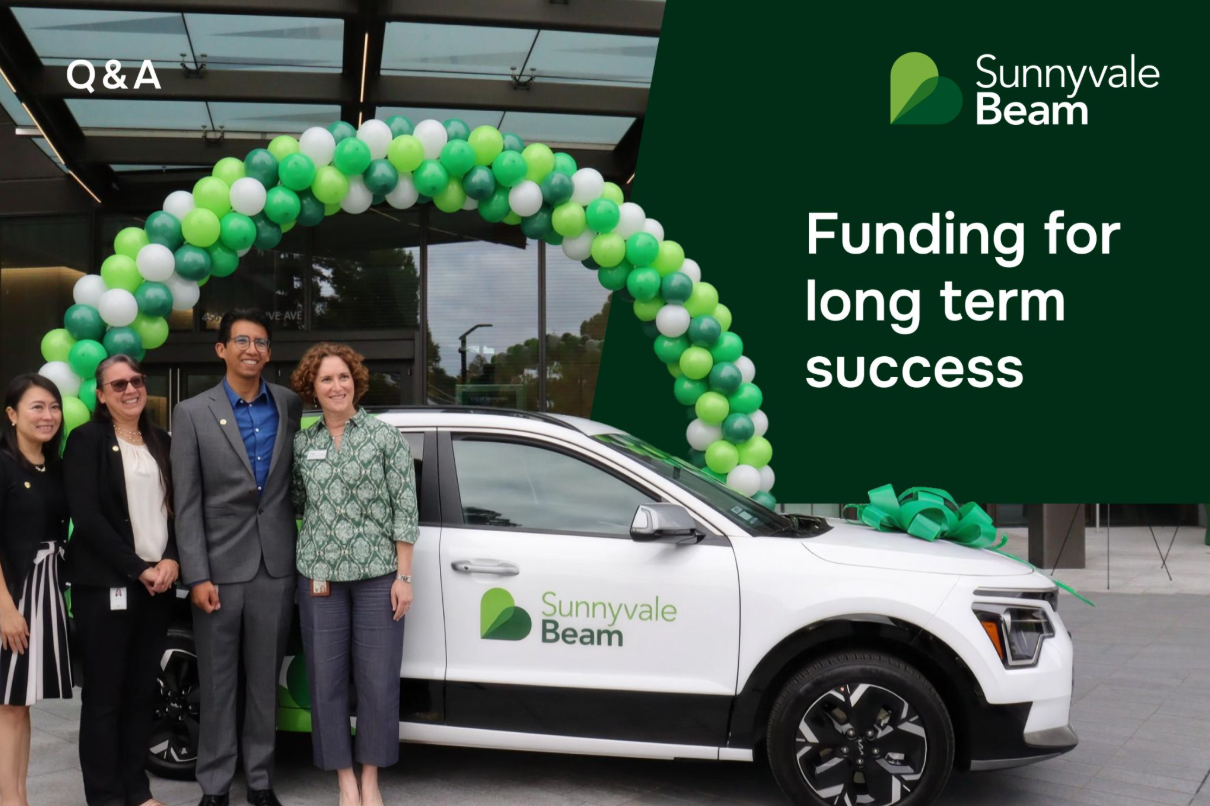
Fresh off the launch of the City’s Sunnyvale Beam microtransit service, we sat down with Erik Trujillo, a transportation planner with the City of Sunnyvale’s Department of Public Works, to hear how the City was able to get such an ambitious project off the ground.
To start, can you tell us a little bit about yourself and what you do for the City?
My name is Erik Trujillo. I'm a transportation planner here at the City of Sunnyvale. Prior to joining the City, I worked for about nine years in the private sector. I've been with the City since 2023 where I started off as a traffic engineer. Then about a year ago, I took over as a transportation planner where I've been working on getting this Sunnyvale Beam project up and running.
Before launching the service, what were some of the biggest transit challenges the City was facing?
So taking us back a few years ago, the City had what we call a study issue. We were looking to find ways to connect students from the high schools to their homes as Sunnyvale doesn't have a dedicated school bus system. A lot of the students were struggling to get to school, especially from the northern part of town because both of the high schools are in the southern part of town and there are not a lot of good north-south connections within the City’s fixed-route network.
And so we started looking into options for providing alternative transit for students including partnering with other nearby cities to see how they were using microtransit services. We looked at implementing a subsidized ride share program or expanding some of the fixed route service to better serve that north-south corridor. Everything was on the table in terms of what we were considering. But the idea for Sunnyvale Beam really came directly out of the community. We had an outpouring of residents that organized and came to our city council meetings and they said, "Hey, you guys are doing this study to analyze all these options. Well, in Cupertino, which is the city right next door to us, they already have a successful microtransit service called SV Hopper. Why don't you join them?” That prompted our council to say, you know what, we're going to listen to the people and we’re going to figure out a way to do this
And once you had converged on microtransit, how did you begin to explore various funding paths?
We knew we wanted to bring in some grant funding but our first attempt actually wasn’t successful. First we tried partnering with our regional transit authority, the Santa Clara Valley Transportation Agency, and we went for a federal grant from the EPA. After we lost on that application, we had the idea to partner with Via and try for the California Transit and Intercity Rail Capital Program (TIRCP) grant, and we were successful in getting $4.1M from that program which we were able to match with an additional $4.1M from our City’s general fund.
TIRCP is a very competitive grant. What do you think was unique about the Sunnyvale story that stood out in the application process?
There were a few things that I think really worked in our favor. The city has historically been very single occupancy vehicle oriented, and you know we're in the heart of Silicon Valley. Only 10% of Sunnyvale's population lives and works within Sunnyvale so we have a real first- and last- mile connection challenge if we want to encourage folks to take mass transit and reduce single occupancy vehicle emissions. That’s a core focus of this grant and so I think we were able to speak really authentically to that and provide compelling data on the impact that adding an all-electric microtransit service could have in terms of connecting users to the high speed rail and enabling what would otherwise be really long single occupancy vehicle trips to become transit trips.
We also had the student access issue that I spoke about earlier, and we do have some low-income disadvantaged communities, many of which are located in that northern corridor that is less well served by the existing transit network. It’s become so expensive these days to own a vehicle, and so providing a solution for these communities was really important to us.
What was the process like in terms of getting the council to agree to match the grant award out of the general fund?
You know, actually it wasn't too hard at all to convince the council, and I think that’s because the residents were so vocal about the want and need for this from the start. At the end of the day the council is here to serve the people and they understood that transportation is really key for giving the community more access and more freedom. You can fund schools but if kids can’t get there, it’s not going to improve educational outcomes. We also have a large senior population, we can fund health centers but again, if the patients can’t reach their appointment, it’s not going to improve health outcomes. And so you know our city council really heard those requests from the residents and they were very willing to provide that funding.
When it came time to pick a partner both for applying for the grant and then also eventually to power the service, what stood out about Via?
I kind of alluded to it earlier but Via has such a strong presence and proven track record in our area. Via was already running similar projects in our neighboring towns of Cupertino and Santa Clara. In addition to that, the city of Sunnyvale already had a small microtransit service with Via called Perry Park Rides which is a project cofunded by VTA, our regional transit agency and the local business district. So we were very familiar with Via and how they work and their expertise in the transit sector. It was like a no-brainer. They've been super helpful, you know always providing their expertise in any subject whether it's the grants or actual operational best practice. They have such a big footprint they are always pulling from their own experience and coming to us saying “oh you know we tried this in another service and it worked really well so lets implement that here or we tried this in another service and it didn't work that well so maybe we don't want to do that.” It's been really helpful to be able to pull from those different sources.
It's very early, you just launched a couple weeks ago, but what have early results looked like?
We launched exactly one month ago, and so far everything has been great. Public reception has been so positive, the community has been really enjoying it, and we’re hitting our target demographics. Ridership has been climbing every week, our operational metrics like productivity are super high and continuing to improve. We're just really excited for the service to continue to grow and for us to start to get some strong data around where there are any potential for expansion opportunities.
What advice would you give to other cities facing some of the same challenges you were?
I think the biggest thing is just understanding what your community's needs are, and doing that by engaging with the community early and often. Too often I think planners just focus on more of the same - we need more trains or we need more buses. If people are not going to use them, then what's the point? In our case, this was something that our community came to us and told us they were really eager for so it’s not surprising to see now that the public reaction has been "Oh, this is such a great service. I heard about this on Instagram and I'm really excited, my kids are going to be able to get to school on time. I'm able to get to my appointments that are all the way across town now." This service is exactly what Sunnyvale needed, but it was because we listened to their community and we gave them what they knew they needed.


