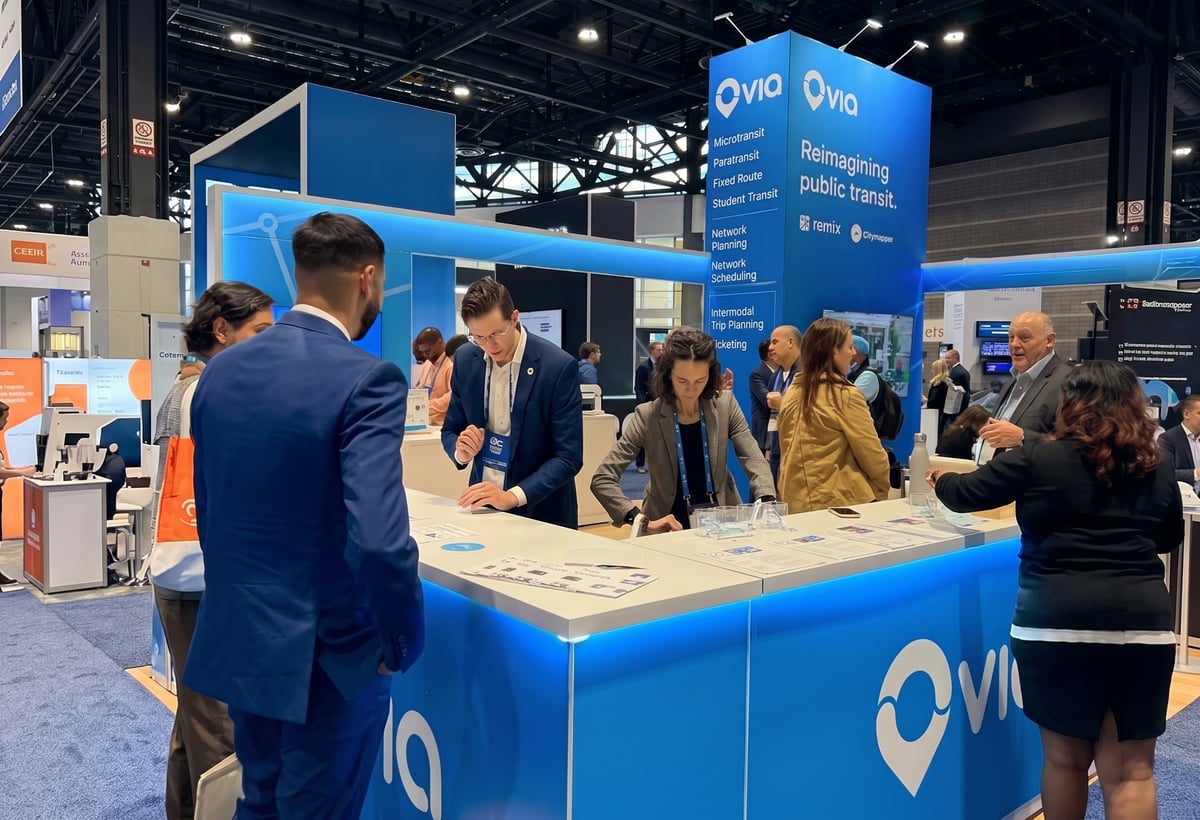
We were no longer talking about innovation in the context of small pilot programs, testing something for a year or two and seeing how it goes. Innovation in our field is happening at an unprecedented pace - and agencies have everything to gain by embracing the new frontier.
It’s clear that transit leaders are tasked with a big job — stretching every operational dollar, grappling with how to harness artificial intelligence responsibly, and setting the foundation for the replacement of legacy, siloed software and operation with truly unified mobility platforms.
Here are my three big takeaways that defined this year's conference:
1. AI has earned its seat at the table
AI was everywhere at TRANSform. And, not just speculative panels about future tech; agencies are deploying AI at scale and generating real-world returns on investment.
What we saw loud and clear is that transit agencies are deploying AI directly into daily operations to solve core efficiency challenges such as:
- Dynamically balanced supply: Optimizing shift plans on the fly based on real-time traffic, seasonal demand patterns, and driver availability.
- Streamline dispatching and paratransit scheduling: Reducing wait times and missed trips for riders with mobility needs, while working towards unlocking same-day or on demand paratransit service.
- Predict maintenance needs: Catching vehicle issues before a breakdown occurs, protecting both the budget and rider trust.
The key insight? AI isn't here to replace human expertise or frontline workers - the Human-in-the-Loop model allows schedulers, dispatchers, and planners to access supercharged decision-making tools while allowing for human oversight and control.
2. Funding for the long term
Agencies are facing structural budget deficits at the exact moment riders are demanding higher frequency, better safety, and cleaner fleets. However, leaders aren't waiting for a miracle bailout—they are actively restructuring their cost models to build long-term resiliency.
Key operational strategies discussed to weather the storm included:
- Microtransit as a fixed-route saver: Instead of running empty, 40-foot diesel buses on low-density routes, forward-thinking agencies are shifting those corridors to flex-route or dynamic microtransit. This preserves coverage while slashing operating costs per passenger mile. The FTA actually recommended this approach in the Ops Committee meeting.
- Data-driven grant applications: Leveraging precise, aggregated mobility metrics across multiple services to present undeniable arguments for state, local, and federal funding that are tailored toward the desired outcomes of the funds.
- The line between operations and technology is blurring: For years, operations has “used technology”, and it’s becoming clearer that those who integrate tech and ops together have been able to produce unprecedented cost saving results
- Public-Private and Software Collaborations: Shifting from heavy capital expenditures to flexible, software-driven solutions that reduce overall total cost of ownership (TCO) across agency fleets.
In a constrained fiscal environment, every dollar saved on an inefficient route is a dollar reinvested in high-frequency core transit corridors.
3. The Power of the Unified Platform: Breaking Down Transit Silos
Perhaps the most resonant theme across every keynote and floor discussion was the critical advantage of systemic integration.
For decades, public transit has suffered from fragmentation. A single agency might rely on one vendor for fixed-route scheduling, another for paratransit, a third for microtransit, a fourth for fare payment, and a standalone app for customer communications. The result? Data silos, frustrated dispatchers navigating four different screens, and a fragmented experience for the passenger trying to make a simple multi-modal connection.
At Via, we’ve long advocated for a single, unified operating system for public transit—and this year’s APTA program validated that vision completely.
Why Integration Wins:
- Unrivaled Network Intelligence: When paratransit, microtransit, and fixed-route systems share the same data backbone, planners get a holistic picture of regional movement. They can easily see where microtransit can feed commuter rail or where fixed-route coverage should be expanded.
- Operational Resilience: In a single-platform architecture, vehicles and drivers can be dynamically reallocated across service types depending on real-time surge demand, traffic disruptions, or driver shortages.
- A Seamless Rider Experience: Passengers don't care how many vendors an agency contracts with; they care about buying one ticket, planning one journey, and getting to their destination reliably. A unified platform makes multi-modal travel intuitive.
Looking Ahead
APTA TRANSform 2026 proved that the transit industry is moving past reactive survival mode and embracing a smarter, more integrated future.
The fiscal headwinds facing our communities are real, but so are the digital tools now available to meet them. By combining practical operational AI, fiscally responsible network design, and unified software platforms, public transit can—and will—emerge stronger, more efficient, and indispensably connected.
I returned home energized by the incredible work happening across our partner agencies. Let’s keep building.


