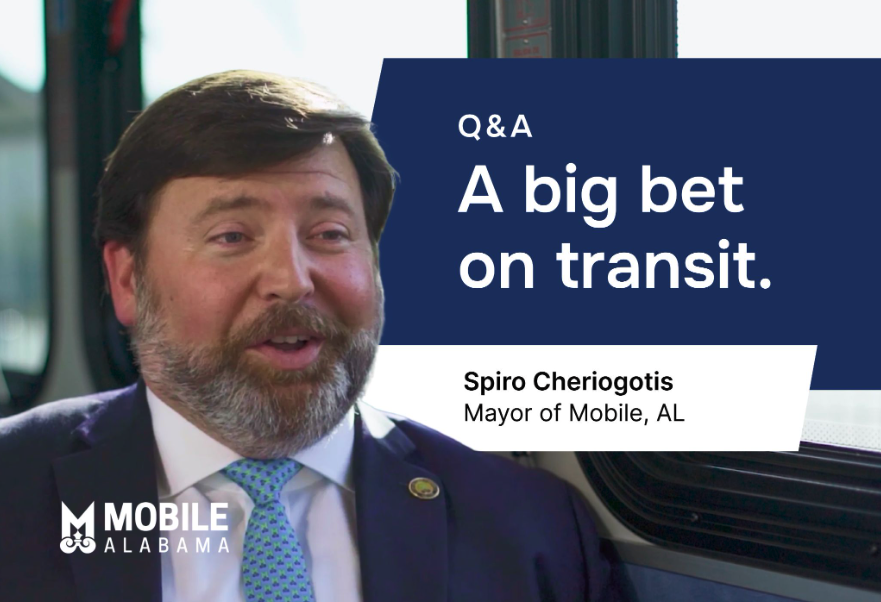
Fresh off the successful launch of a complete redesign of the City’s transit network, Mayor Spiro shares why building a world class transit network is pivotal to the City’s growth strategy for years to come.
To start, can you tell us a little bit about yourself and what you do for the City?
I'm Spiro Cheriogotis, father of 4 and I am the 109th Mayor of the City of Mobile, which seems like a lot of mayors, but I have fact-checked that. Prior to being elected, my background was in the legal system where I served as a prosecutor, a private attorney, and a judge.
As someone who has come into City leadership from a non-transit background, what has drawn you to transit as such a key area of focus for your administration?
I've always liked really healthy public transit systems. I love visiting cities and places that have a really robust transit system because you don't really have to worry about how you're going to get anywhere. You've always got an option.
Whether it's the subway in New York, or in New Orleans, which is very close to here—that open-air, electric, trolley-on-track system, the idea of Mobile having a better transit system has always been in my mind. As I started campaigning and started to learn more about some of the issues with our existing transit system, the more I looked into it, the more need I saw, and also maybe the more opportunity I saw. Wanting to make that a healthier system was something I became focused on kind of organically.
What were some of the issues you were seeing with the old transit network?
One item was our relatively empty buses. And at one point, there was an estimate that for every person that rode a bus—every person that stepped on a bus—it cost the city $17. And that was, to me, more an indictment of the lack of ridership than it was the actual cost of the service. We have bus stops that really have never been invested into, so they're not attractive, they're not comfortable, they're often not covered.
The routes themselves, to me — I consider myself a fairly intelligent person — were very confusing. How do you get from point A to point B? They had been adjusted so many times that I felt like they had gotten out of whack with logic and reason. And so I thought that routes needed to be simplified.
And what I really wanted to do, what I know we were missing out on completely, is choice ridership. There was absolutely no one who was using the transit system that this was not their only and, frankly, last option. And I think that a really healthy, vibrant transit system, that's not the case. And so to address that, we needed to change the mindset around public transit. We needed to invest more in the amenities around the vehicles themselves. One of the changes we’ve made that people are most excited about is bringing in the trolley which is attractive, it's fun, and it makes you excited to ride.
In terms of your administration’s priorities, what sort of things does having a better transit system unlock?
Transit is very closely linked to one of my big priorities which is workforce development. We need to be able to connect citizens to opportunities that we have here locally.
In Mobile, we have so many growing, increasing opportunities to build careers that can really create wealth, whether you have a college education or not. We have a lot of really high-value manufacturing jobs, a ton of opportunity that just hasn't always been here. And to support this growth, we've got to have the workforce. And I want to grow that workforce right at home. I think the best way to do that is to make sure they can get to where they need to go, whether that's an internship, an apprenticeship, whether it's skills training. We have all those programs, and we have those opportunities, and there are a lot of people that would love to seize them. But as a recent chamber study showed, 31% of our workforce who are actively looking for work lack reliable transportation, and they said that was their primary barrier to building a life and seizing that opportunity. If you can reactivate a third of your people through transit, that’s a huge opportunity for your city.
Another big priority for me is tourism. Most southern cities are designed around the automobile, but Mobile's a little different. A large portion of Mobile is very old with streets dating back to the 1800s. And so it naturally does have more of a walkable character in many areas of town. And I think public transportation feeds directly into that walkability. If you have a robust, easy-to-use, high-frequency transit system, people can leave their house without having much of any plan on exactly how they're going to get to where they're going, but they can get there. And maybe that's walking a couple blocks, maybe that's dialing up a microtransit vehicle. It's easy to be a tourist in a place where it's easy to move around.
Mobile is not always recognized for the really historic city that it is and the fun city that it is. It's a fun place to go and eat dinner and go see a show and go out and have a couple of drinks with your friends. I do think Mobile has an opportunity to seize a lot more of those eyeballs and vacation dollars. And I would like to see that happen.
What role do you think microtransit plays into a healthy transit system?
Microtransit specifically is a huge part of our plan. It's fairly new for our area. For a few years we were running a microtransit pilot program with our local Chamber of Commerce, and it showed great success. Now we’ve rolled out microtransit to a much larger area to supplement our fixed route and expand access to the network and we’re seeing unprecedented demand. To go from empty buses to huge demand, that's a great thing.
What’s been challenging about changing the network
In order to really utilize our transit system of the past, you had to be an expert. You had to understand these routes, the timing of these routes, how to get from point A to point B. And we had, I would estimate, about 600 experts out there, true experts that really utilized the system. And now we're changing it, and there's fear attached to that. There's just uncertainty that causes anxiety.
A big part of our community engagement strategy has been to be aware of that anxiety, and address it in every way we can. Dialing up a microtransit vehicle instead of trying to time out your bus routes is a new thing, and it's very different, especially for some of our more seasoned citizens.
And we're just doing everything we can to communicate directly with them and ease their concerns and show them a clear pathway of, "Hey, I know this is how you've always done it, but here's another way." And it can be very similar to the old way. It can also be much more convenient and a little more direct to where you're going.
What advice would you give to other City leaders who are facing similar challenges?
I can't say what's best for every mayor of every city. I think every city is different, and the needs of every city are different. But there is—and I think you're seeing it in stats—there's a desire with the younger generation for transit. They're not waiting at the DMV to get their driver's license on the day they turn 16. I think the likelihood is that over the next 10 to 20 years, there will be more consumers out there for public transportation, more people very much interested in having reliable transportation. And I think you just have that opportunity to capture those dollars and those riders. It feels a bit to me like we’re at a transformation point that maybe hasn’t happened since we went from horse and buggy to vehicles. So I think it's a calculation. Is it worth your dollars on the front end to make a more robust system that creates greater usage?
I'm kind of living on that bet right now. I am betting with Mobile that there is a market, that we can increase ridership, that we can increase frequency, and that we can get more people to where they're going conveniently. And I'm hoping it pays dividends. We'll find out.
But I know it's going to help a lot of my citizens. I know it's going to help the people who are dependent upon it. And a city is not a business. Many times we have to run it like a business, but we also have to provide services that we know we'll never make money from.
We're serving the citizens. And I think transit can be viewed that way. You are providing a service that otherwise citizens would not have access to. But I do think on the long-term bet side of it, there's money to be made. There is a way to really justify that investment through increased tourism, through increased ridership, through increased employment. And I think it's worth the bet.
But I think with the technology that we have available to us for tracking and booking and riding and really the data it creates to help us understand what's working and what's not, there's probably never been a better time to try something new.


